
Keynotes
CILECT Congress 2026
27-31 October 2026
Who Owns the Story? Teaching Freedom from the Classroom to the Festival
Film education does far more than transmit craft: it shapes who is authorised to speak, which histories are preserved and whose work becomes visible. Today, however, education extends beyond degree-granting schools. Short laboratories, workshops and festival-linked programmes often provide concentrated mentorship, professional networks and rapid access to international recognition, while formal schools offer deeper artistic, theoretical, ethical and collaborative formation. What can these models learn from one another?
At heart, this is a question of power. How can teachers share knowledge and discipline without turning authority into aesthetic conformity? How can students challenge archives shaped by colonial or political forces, place official records in dialogue with memory and testimony, and enable communities historically treated as subjects to become authors of their own representations? And how can schools, laboratories and festivals collaborate without treating awards as the sole measure of success or replacing one system of gatekeeping with another?
Ultimately, should film education merely prepare students to master existing forms and enter existing institutions or enable them to create new forms, reclaim narrative authority and reshape the institutions through which stories are preserved and made visible?
keynote speaker
Jihan El‑Tahri
Jihan El‑Tahri is an award-winning Egyptian-French filmmaker, producer, writer, visual artist, mentor and institution-builder whose work explores power, collective memory and the unfinished promises of liberation. Born in Beirut, she studied political science at the American University in Cairo before beginning her career as a foreign correspondent covering Middle Eastern and African politics. Since 1990, she has directed more than fifteen documentaries, many based on archival research, for the BBC, PBS and Arte. Her major works include the Emmy-nominated House of Saud, Cuba: An African Odyssey, Behind the Rainbow, The Price of Aid, Egypt’s Modern Pharaohs and Nasser, which premiered at the Toronto International Film Festival. Combining archival images with testimony, her films challenge colonial perspectives and official histories while examining how liberation movements can become systems of power. She extends these enquiries through visual art installations presented at major museums and biennales worldwide and through essays and books published by Penguin and Grasset. A member of the Academy of Motion Picture Arts and Sciences since 2017, El‑Tahri founded Big Sister, formerly led DOX BOX, mentors filmmakers and artists through international laboratories, and has served organizations including IDA, PFI, FEPACI and the Guild of Filmmakers in the Diaspora.
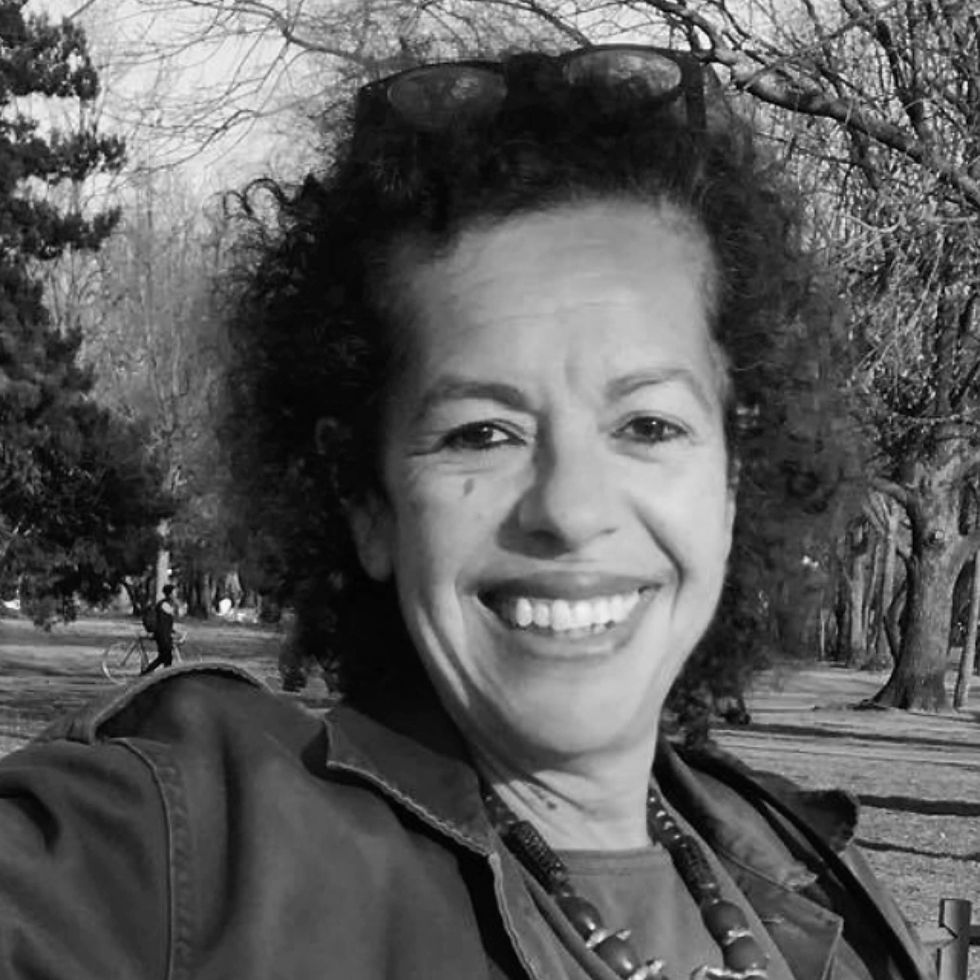
"Give Me Something I've Never Seen Before": Radical Imagination in the Age of AI
We are in a crisis of vision. Now more than ever, people need a vision of the future unbound from corporate priorities and political compromise.
Film has the power to show us what's possible. Right now, that power is being handed to a technology built to predict, to repackage the past, rather than imagine a divergent path. We're told that the future of the industry lies in pattern-matching algorithms built to anticipate the next word or pixel, trained on troves of unfiltered data.
From authorship, to acting, to effects: AI is transforming the industry and how those within it are valued. It also threatens the revolutionary potential of the craft at a moment when bold artistic vision is most desperately needed.
This talk examines what a genuinely human-centred response would look like - one that confronts bias, unequal access, intellectual ownership, creative risk taking, and future employment in the industry. How do we protect what is uniquely human in our storytelling while preparing the next generation of filmmakers for technological change? Can we leverage AI to challenge rather than exacerbate inequality? How do we continue to encourage students to critically interrogate themselves and reimagine their futures within a rapidly shifting paradigm?
keynote speaker
Y-Vonne Hutchinson
Y-Vonne Hutchinson is an entrepreneur, author, and speaker. She is the founder and CEO of Superessence, an AI-powered marketing intelligence platform that helps brands make smarter strategic decisions, and founder of ReadySet, one of the US's leading workplace culture consultancies. Her companies have advised leaders and teams across media, technology, finance and government; including Amazon, Warner Music Group, the Television Academy, the Library of Congress, and Google.
Before starting ReadySet, she worked for nearly a decade as an international human rights lawyer in countries that included Afghanistan, Thailand, and Burma. She holds a J.D. from Harvard Law School and a B.F.A. from Carnegie Mellon University.
Y-Vonne is also the author of How to Talk to Your Boss About Race: Speaking Up Without Getting Shut Down, named one of Amazon Editors' Best Business Books of 2022, and her work has been featured in outlets including the New York Times, The Washington Post, Elle Magazine, Fast Company, Academic Medicine, and MIT Technology Review. Across her work—as a founder, advisor, writer, and speaker—she explores the intersection between technology, human judgement, culture, and organizational effectiveness. She currently serves on the board of California Tech Equity, and the Tony award winning Pasadena Playhouse.

‘Identity’ – the be all and end all of storytelling.
For over sixty years I’ve been considering the role ‘identity’ plays in communicating the excitement and challenges of making sense of the world.
What is it that helps one human being successfully communicate with others – time and again, I return to the belief that discovering and rediscovering our sense of a shared identity is ‘everything’.
keynote speaker
David Puttnam
A British film producer, educator and environmentalist, Lord David Puttnam is Chair of Atticus Education, an online education company that delivers audio-visual seminars all over the world. David spent thirty years as an independent producer of award-winning films including The Mission, The Killing Fields, Chariots of Fire, Midnight Express, Bugsy Malone and Local Hero. Together these films have won ten Oscars, thirteen Golden Globes, nine Emmys, thirty-one BAFTAs, four David di Donatellos, and the Palme D'Or at Cannes. In 1997, he was appointed to the House of Lords and during his time as a parliamentarian, he agitated unrelentingly in public policy for education, climate change, and the creative industries. In 2019, he was appointed Chair of the House of Lords Select Committee on Democracy & Digital Technologies, which was established to investigate the impact of technologies on democracy. David was awarded a CBE in 1982 and a knighthood in 1995. He is a Commander of the Order of Arts and Letters in France, and has more than 50 honorary degrees from universities worldwide. He was Ireland’s ‘Digital Champion’ from 2012 – 2017 and was granted Irish citizenship in 2022. He retired from the House of Lords in 2021 and now focuses on his work in education.

What Graduates Will Walk Into: How the Screen Industry Is Really Adopting AI
Film educators are under pressure from two sides at once.
On one side, film schools are being asked to respond to AI quickly, even though the industry itself still can’t say where workflows will land, which skills will matter or how careers will change.
On the other, many students hold principled boundaries on AI, risking a gap between what they will accept in the classroom and what they may meet in their first job.
Drawing on a pilot survey of 125 producers, technical practitioners, writers, AI filmmakers and students undertaken earlier this year, this session shares how the industry that graduates are entering is adopting AI.
Emerging trends show that companies are adopting AI faster than the people who make the work, that rights and ownership are key, and that practitioners who engage with AI in their workflows actually report less concern about their careers. In contrast, students’ responses indicate that some have already drawn a firm line on its use.
How can film educators best navigate this tension? How do we teach AI literacy as awareness, not just tool training? And how do we help students have the agency to choose where to draw their own lines whilst understanding the potential professional implications?

Neil Peplow
keynote speaker
Neil Peplow leads Adobe’s engagement with UK film schools and higher education, working with faculty leaders on how the latest creative technology can support their curriculum. He shares the latest industry insight with educators and brings their feedback back to Adobe. His career spans more than three decades in film production, education and cultural policy. He began at Ealing Studios and became a producer, with credits including Waking Ned Devine. As Head of Production at The Film Consortium, he ran a £30m National Lottery franchise overseeing films including The Proposition and My Summer of Love. He went on to direct film skills policy at Skillset and was COO of Met Film School. As CEO of the Australian Film, Television and Radio School (AFTRS), he introduced an Applied Innovation Research programme. At the British Film Institute (BFI), he led the government-commissioned BFI Skills Review, before becoming CEO of London Film School (LFS). At NEOM he built the NEOM Media Academy with Public Investment Fund backing, training 1,500+ Saudis and placing 300+ in industry. Neil authored AI Adoption in the UK Screen Sector (2026) and holds an NFTS certificate in AI protocols and practices for film and TV